Step 0: The manufacturer
Manufacturer according to the Machinery Regulation
According to the Machinery Regulation 2023/1230 the manufacturer’s definition is:
(18) ‘manufacturer’ means any natural or legal person who:
- manufactures products within the scope of this Regulation or who has those products designed or manufactured, and markets those products under its name or trademark; or
- manufactures products within the scope of this Regulation, and puts those products into service for its own use;
A similar definition can be found in other European directives and regulations.
The manufacturer is one of several actors in the product supply chain and has its own obligations. More information about actors and their obligations can be found in the ‘Blue Guide’ by clicking here.
Is a machine builder always manufacturer?
When you, as a machine builder, manufacture a machine according to drawings and information supplied by your customer and it has not been agreed upon who will be the manufacturer, you, the machine builder will be the manufacturer. This is because it is you who markets the machine. So, make clear agreements (for example in the order confirmation) who will be regarded as the manufacturer. You, as a machine builder with no part in the engineering process, might want to exclude yourself from that role.
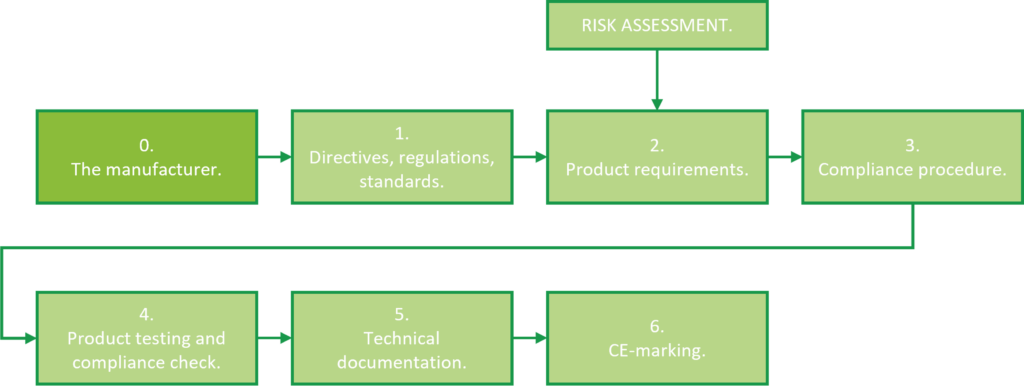
The manufacturer assumes all obligations under the relevant directive(s) and/or regulation(s) and therefore completes all steps in the CE-marking process.
Assemblies
The manufacturer role can change when several machines are integrated into a new one. You can read about this in in §38 (page 36) of the ‘Guide to application of the Machinery Directive 2006/42/EC’.
Note: There will be a guide for the Machinery Regulation 2023/1230, however it is not expected in 2026.
Assemblies, some examples
In the examples below:
- The actor above the dotted line is the supplier.
- The customer and/or end-user is under the dotted line.
- The lower text describes who is the eventual manufacturer.
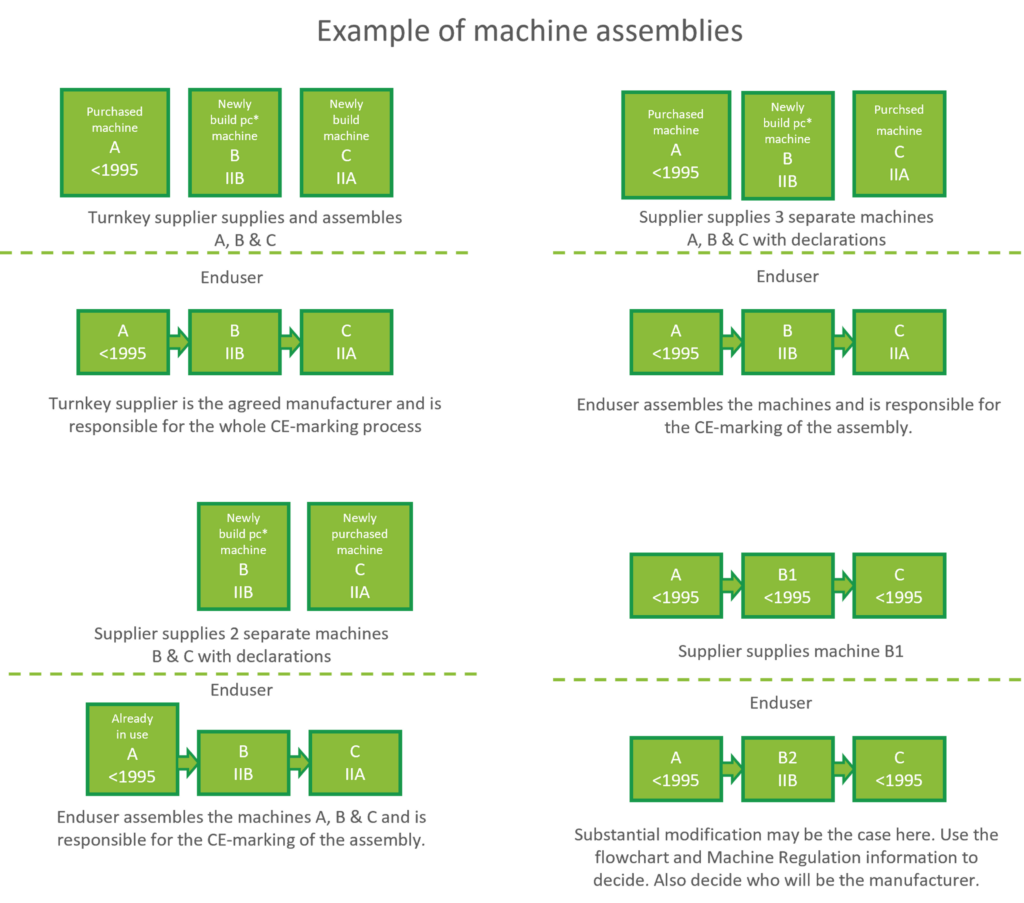
Substantial modification
When you make a substantial modification to a machine, you become its manufacturer.
Substantial modification is defined in the Machine Regulation 2023/1230 as follows:
(16) ‘substantial modification’ means a modification of machinery or a related product, by physical or digital means after that machinery or related product has been placed on the market or put into service, which is not foreseen or planned by the manufacturer, and which affects the safety of that machinery or related product, by creating a new hazard, or by increasing an existing risk, which requires:
- the addition of guards or protective devices to that machinery or related product the processing of which necessitates the modification of the existing safety control system; or
- (b) the adoption of additional protective measures to ensure the stability or mechanical strength of that machinery or related product;
Carrying out a substantial modification results in:
Article 18
Other cases in which obligations of manufacturers apply
A natural or legal person that carries out a substantial modification of machinery or a related product shall be considered to be a manufacturer for the purposes of this Regulation and shall be subject to the obligations of the manufacturer set out in Article 10 for that machinery or related product or, if the substantial modification has an impact on the safety of only machinery or a related product that is part of an assembly of machinery, for that affected machinery or related product, as demonstrated in the risk assessment.
The person who carries out the substantial modification shall in particular, but without prejudice to other obligations set out in Article 10, ensure and declare on its sole responsibility that the machinery or related product concerned is in conformity with the applicable requirements of this Regulation and shall apply the relevant conformity assessment procedure as provided in Article 25 (2), (3) and (4) of this Regulation.
A non-professional user who carries out a substantial modification to his or her machinery or related product, for his or her own use, shall not be considered to be a manufacturer for the purposes of this Regulation and shall not be subject to the obligations on the manufacturer set out in Article 10.
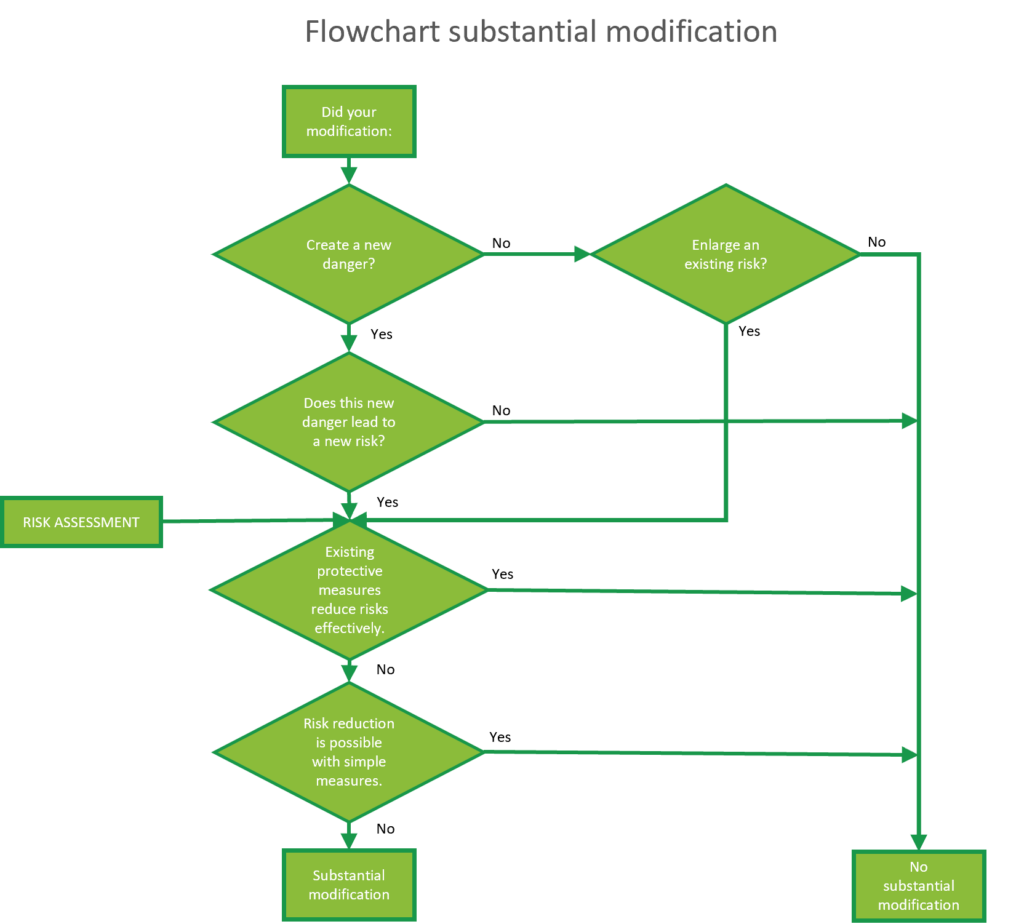
Substantial modification aid
The flowchart below is an aid to determine whether a modification is substantial. The Netherlands labour Authority composed a clear procedure how to deal with substantial modifications. It is in Dutch and you can read it here.