Step 1: DRS
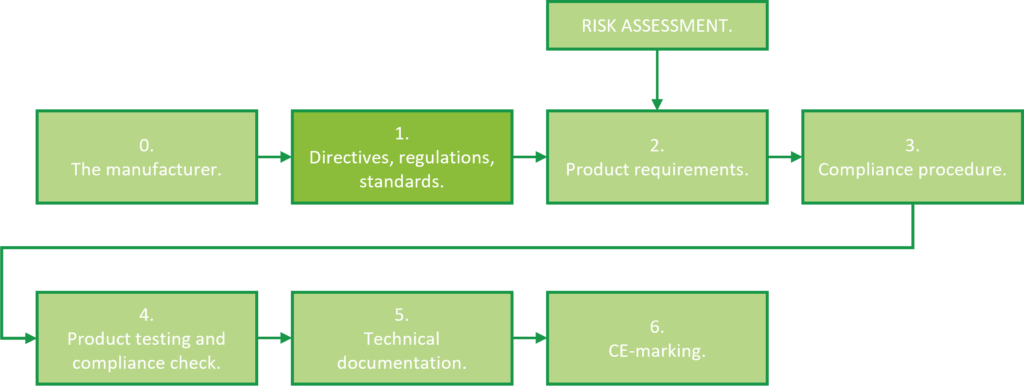
Directives and regulations are European laws.
The main difference between these two is that regulations are directly binding on EU member states and directives have an obligation to adapt national legislation to that directive. A regulation is a ‘higher’ law than a directive.
For example, the Machinery Directive has been applied in the Netherlands in the Machines Commodities Act Decree. Replacing the Machinery Directive by the Machinery Regulation in 2027 will make the Machines Commodities Act Decree redundant.
More information about directives and regulations
There are many directives and regulations. The flowchart below helps you to determine which a product must comply with.
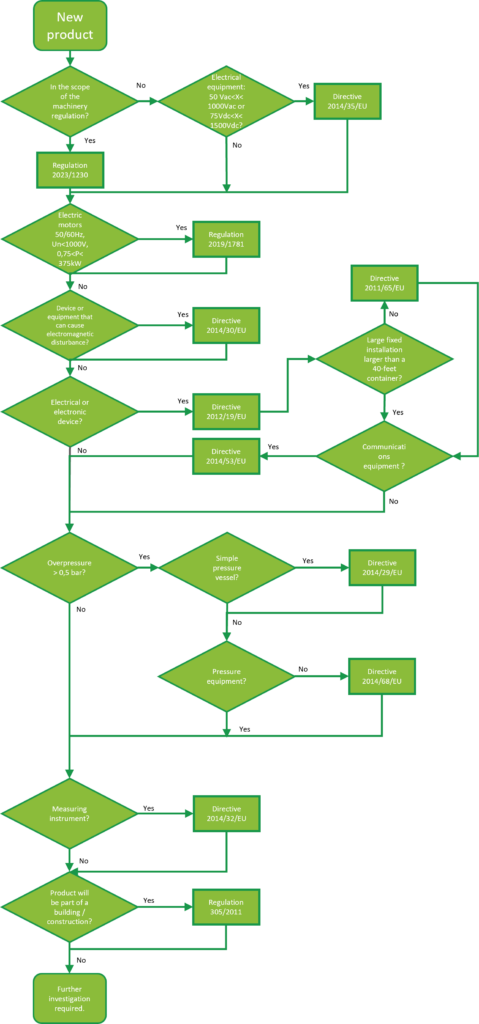

Additional information about the scope of directives and regulations can be found on this page .
The CE-roadmap file which is part of the CE-assistant tool includes directives and regulations that can be fully evaluated depending on the format you have chosen.
You should realize there are more directives and regulations than those in the diagram.
An up-to-date list of directives and regulations can be found here.
Harmonized standards
Standards are not laws. However, applying them is recommended: Standards are seen as the current state of science and technology. Using them therefore proves that your machine or product is up-to date. Regulations and directives always cite harmonized standards in their text. The Machinery Regulation does this as follows:
CHAPTER III
CONFORMITY OF PRODUCTS WITHIN THE SCOPE OF THIS REGULATION
Article 20
Presumption of conformity of products within the scope of this Regulation
1. A product within the scope of this Regulation which is in conformity with harmonised standards or parts thereof the references of which have been published in the Official Journal of the European Union shall be presumed to be in conformity with the essential health and safety requirements set out in Annex III covered by those standards or parts thereof………
So, complying with standards is much faster, more convenient and more accepted in the market than drawing up a methodology yourself to prove compliance with Annex III (essential safety and health requirements regarding the design and construction of machines and related products).
The CE-Assistant tool includes a section where harmonized standard, relevant to the chosen CE-roadmap format, can be consulted.
A, B and C standards
There are more standards than directives and regulations together. Standards indicate the current state of technology and become, for that reason, outdated quickly. Always check the validity of a standard before use. Standards are created by so-called standard or technical committees: Substantive experts in the area covered by the standard.
Each standard indicates in the foreword and/or introduction which committee has examined it and whether the standard is an A, B or C standard:
- A-standards (basic safety standards) which provide the basic concepts, design principles and general aspects that can be applied to all machines. An example is NEN-EN-ISO 12100:2010 ‘Safety of machines – General design principles – Risk assessment and risk reduction’.
- B standards (generic safety standards) covering one safety aspect or one type of safety device that can be used for a wide range of machines:
- B1 standards that address specific safety aspects (e.g. safety distances, surface temperature, noise);
- B2 standards that address safety features (e.g. two-hand operation, locking devices, pressure-sensitive features, guards);
- C standards (machine safety standards) that cover detailed safety requirements for a particular machine or group of machines.
For an up-to-date harmonized standards list? click here.
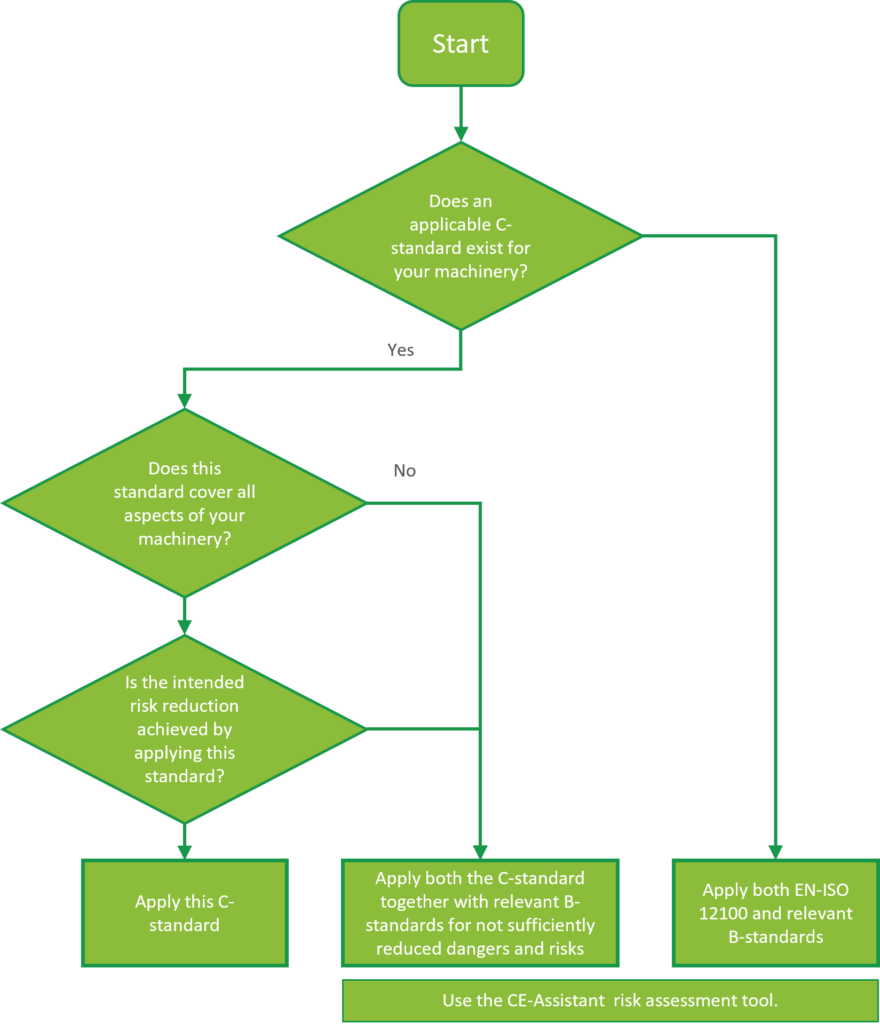
The flowchart below shows how B- and/or C-standards are used.
Link naar nieuwe pagina met pdf’s
National legislation
Although most legislation is European, Member States are often free to impose stricter or additional legislation.
This includes:
- Road Traffic Act;
- Occupational health and safety legislation;
- Mandatory inventory from the working conditions decree;
- Etc.
Checking this is therefore necessary. Requirements from this national legislation must also be applied in the design. National legislation is not integrated in the CE-Assistant tool.
A help to identify applicable national legislation is this YOUR Europe link.
Result of step 1
An inventory of all product legislation that applies to your machinery.